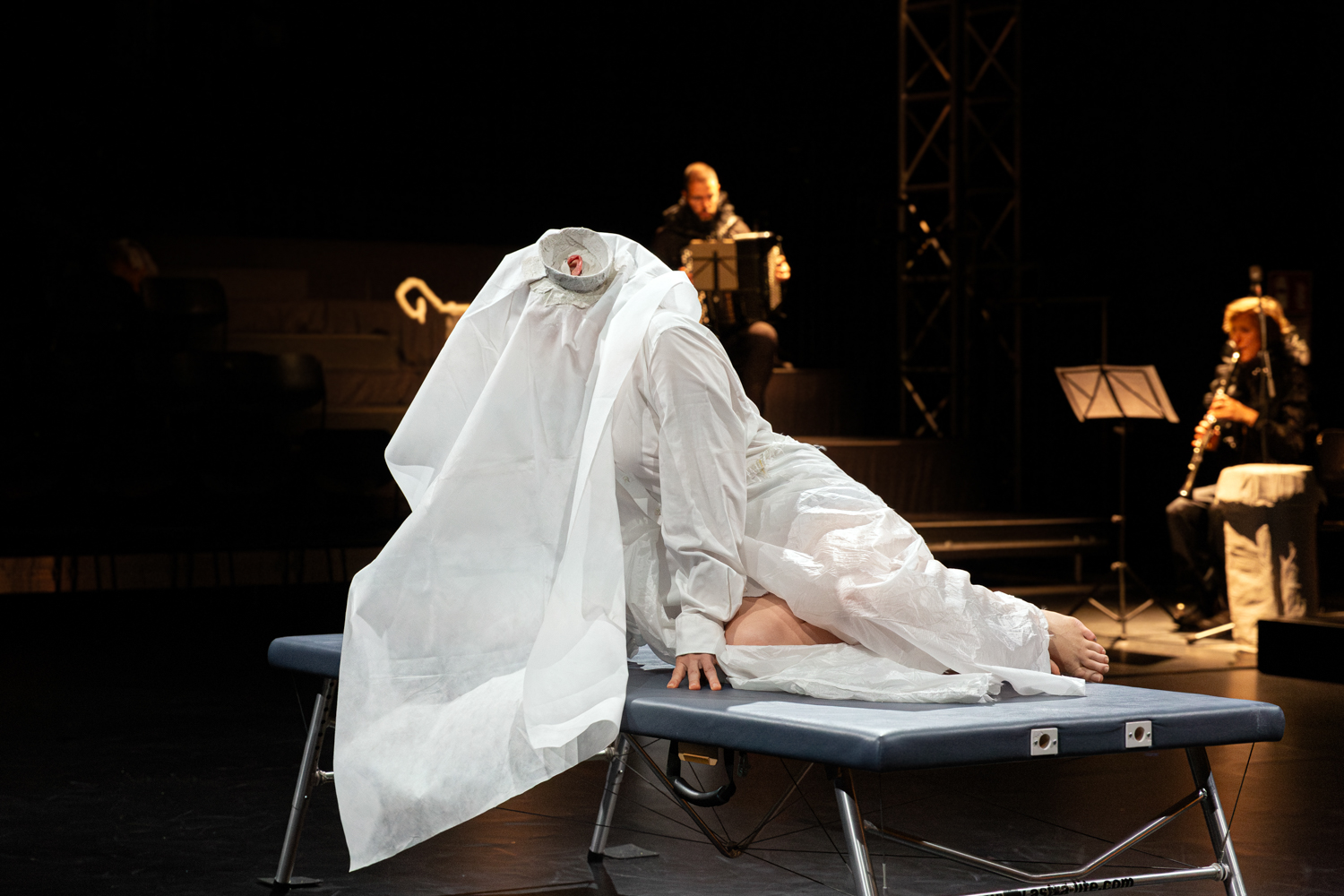
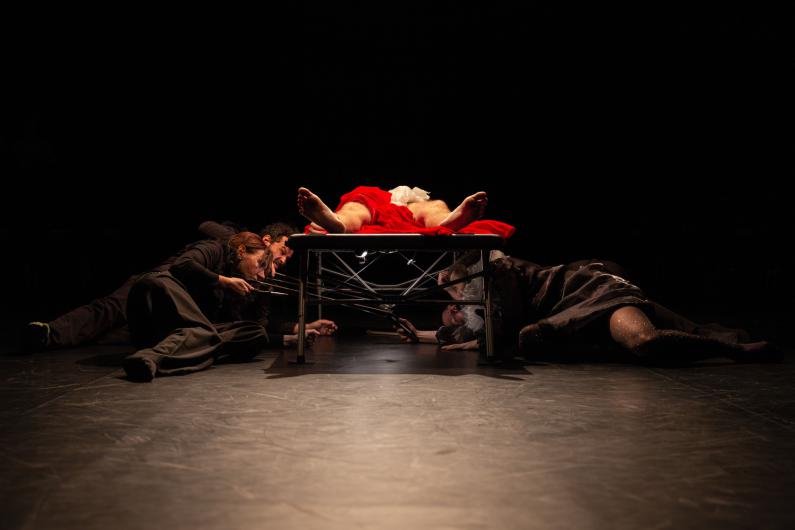
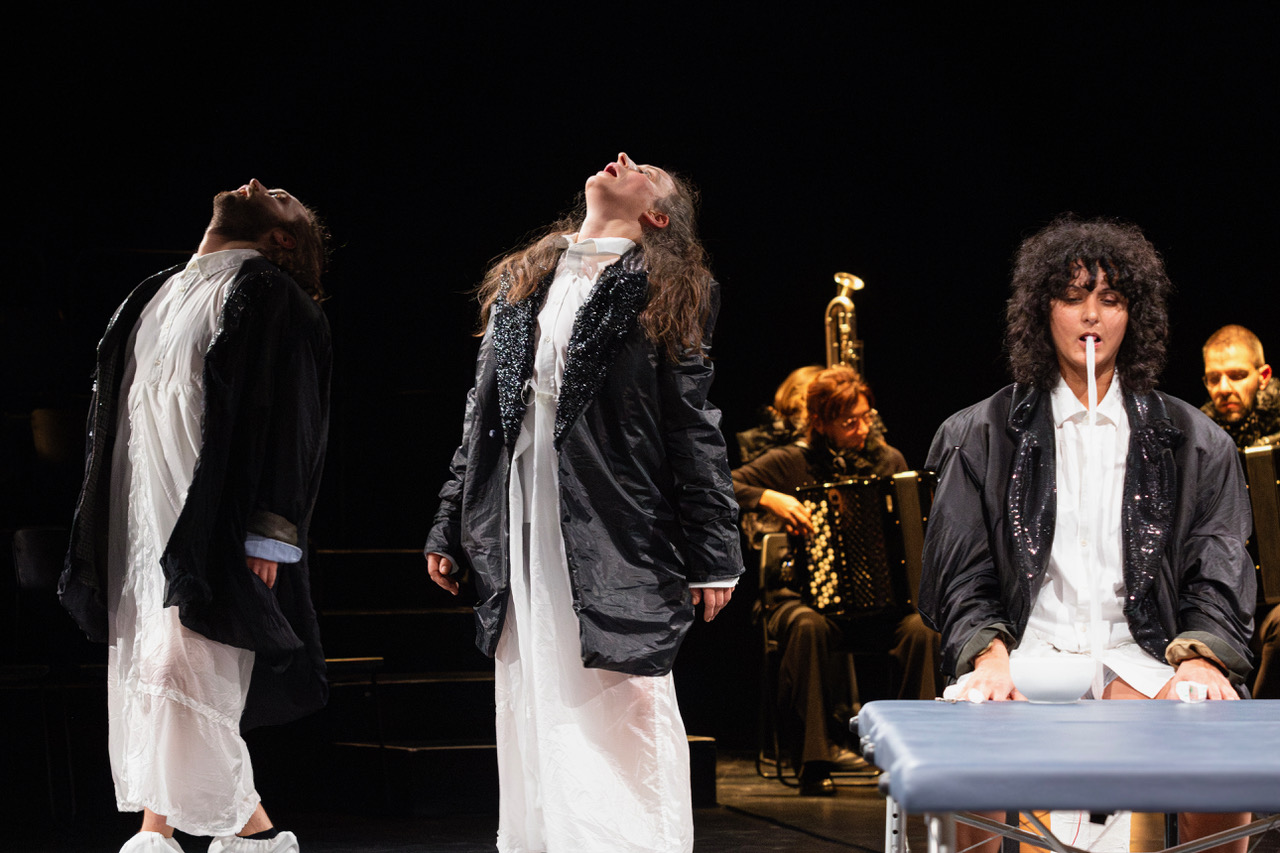
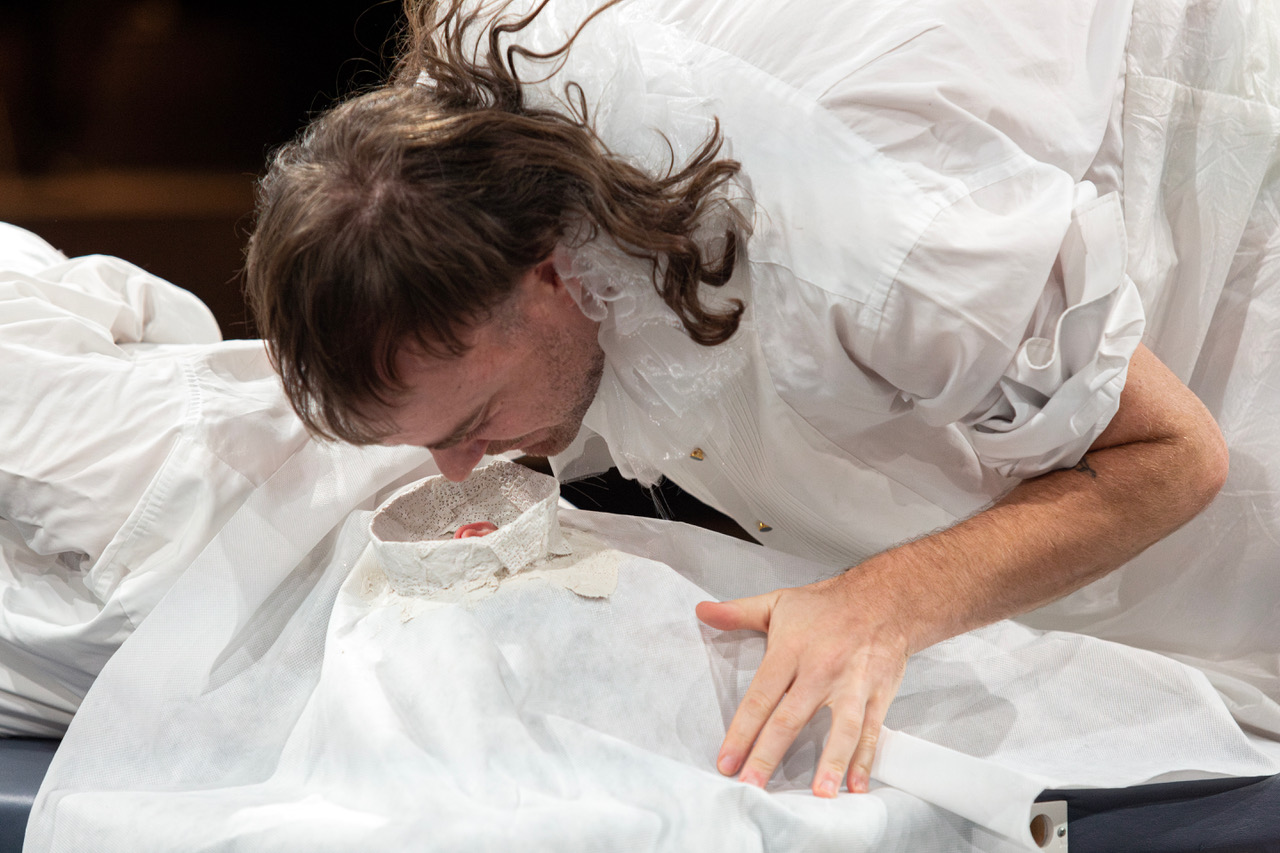
We Are All Mothers (2024)

concept, choreography: Anne Juren

performer: Anne Juren, Samuel Feldhandler, Linda Samaraweerova, Alex Franz Zehetbauer

  • line-up: 4 performer, 2 accordions, contrabass clarinet, contrabass
  • duration: 70 minutes
  • date of premiere: 28.11.2024, brut nordwest, Wien Modern

We are all mothers (WAAM) is a musical-choreographic composition. As “healing” for a collective symptom, the piece navigates between health and art, expanding choreography to heal various ailments of the body. It is less about pathology and more about illuminating the urgency of examining symptomatic affects of the world we live in. The symptoms that come from within the participating performers transform into collective symptoms – and are treated by everyone in community. Each performer in We are all mothers acts both as a dancer and as a body practitioner.

Who is under treatment here: the audience, the performers, the theatre space? We Are All Mothers WAAM is a journey to collective healing that draws on the fact that all our bodies and experiences are connected. Together, the performers create a space in which the individual and the collective melt into one. Bringing their individual symptoms to the stage, they transform them into joint experiences, challenging the separation between health and art and creating co-existence, co-regulation, understanding and a sense of support. The audience witnesses and becomes part of this transformation process through dance and music that dissolves the lines between performer and spectator, healer and patient.

Treatment in We Are All Mothers WAAM is turned into a both choreographic and musical composition, metaphorically, but also literally. Choreography plays a crucial part in this healing process. Including theatre machinery in the performance creates a holistic environment in which every single element contributes to the overall experience. This concept emphasises collective care while challenging the typical idea of medical treatment as an individual process and presenting it instead as a communal, collective endeavour. Everybody’s experiences and contributions come together in a joint composition. By acknowledging and accepting differences, the performers create an environment that is reflected in a choreography in which the movements of individuals together make up the collective narration. We Are All Mothers WAAM is a tribute to Anne Juren’s mother, who passed away in the summer of 2022.

SAMPLING

In 2015 I was invited to work together with the Zagreb based choreographers Petra Hrašćanec, Ksenija Zec, Saša Božić on a new performance named “SAMPLING”.

Matea Bilosnić, Josipa Štulić, Marko Jastrevski, POGON Zagreb May 2015

When I watched your footage, where you start with just putting the human body and working with this small gestures that may look like coincidences/natural deviation, maybe one might not even recognize that the body is already “dancing” – it immediately came to my mind starting my musical material in the same way. so since the musical setup is just speakers and electricity, I began working only with electricity noises (the acoustical natural deviation from silence in every place where speakers and electricity are). This would be Track-01.
In Track-02 I tried to find a musical link for your idea of the “changing weights” with the bodies – I think the link should be just on abstract level but not synchronious in time, cause I dont want to emphasize this small movements acoustically, this might look/sound clownish.
Track-03 is a musical texture I could imagine for the eye-blinking moment – small, but dense activity.
Track-04 now would be the opposite – bigger movements, but quite slowly, desoriented.
Track-05 is then the final activity, lots of movement,  fast running, jumping

Wassermusik Suite No.2

Wassermusik Suite No.2 Warnow Version

Sebastian Gräfe, Matthias Kranebitter,
Projekt im Rahmen des Stipendiums der Akademie der Künste Berlin

Komposition zum ehrenvollen Empfang eines Flusses im Meer
Version für die Warnow mit 5 Posaunen

Posaunisten: Florian Juncker, Matthias Müller, Thomas Moore, Alon Stoler, Vladimir Veres

Ausgangspunkt der Zusammenarbeit des bildenden Künstlers Sebastian Gräfe und des Komponisten Matthias Kranebitter ist der Gedanke, einem Fluss bei seiner Ankunft im Meer besondere Ehre zu erweisen. An der Mündung ins Meer durchläuft der Fluss einen Transformationsprozess. Er ist zu maximaler Größe gediehen und endet zugleich, löst sich auf und geht in etwas Anderes über.
Zu diesem Anlass spielt eine Blaskapelle eine speziell für den Fluss geschriebene Komposition. Durch ihren Einsatz bei Begräbnis und Prozession bis hin zum Staatsempfang ist die Blaskapelle Sinnbild westlicher Traditionen. Hier spielt sie für den Fluss, sie „vermenschlicht“ ihn und macht ihn dadurch greifbarer. Die humorvolle Geste erlaubt uns, leichter mit dem Fluss, mit der Natur in Bezug zu treten, Theatralik und Schwere werden dabei spielerisch vermieden.
Die musikalische Komposition bildet den Fluss jedoch weder ab, noch handelt es sich um eine schlichte Huldigung; vielmehr ist das Werk rückübersetzt in die Logik des Flusses. Zum einen finden die musikästhetischen Qualitäten fließender Gewässer in ihrer Abhängig von Temperatur, Fließgeschwindigkeit, Salzgehalt etc. Beachtung in der Komposition. Desweiteren werden die Blasinstrumente teils direkt in das Wasser geleitet – die Komposition spricht also direkt die Sprache des Flusses.