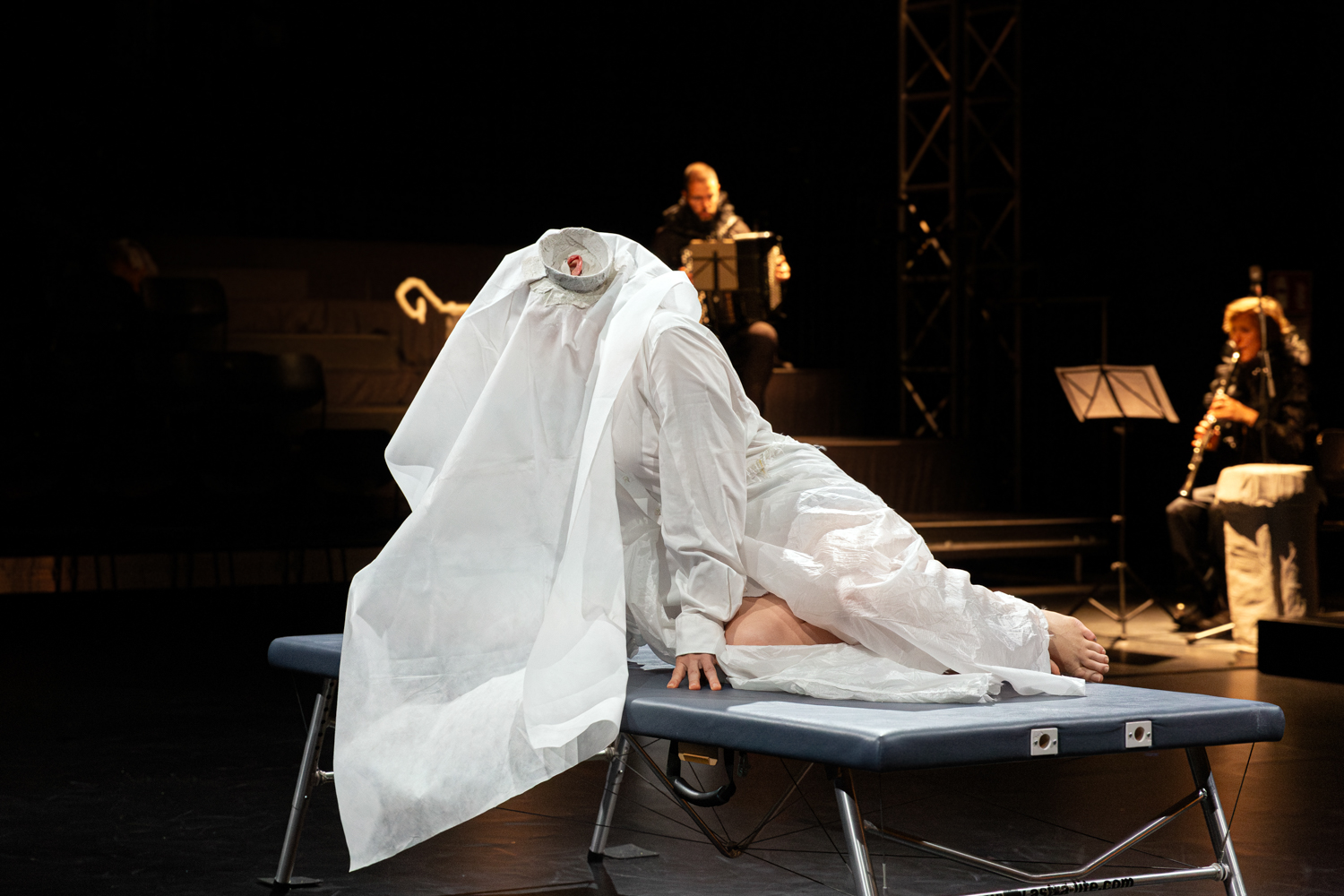
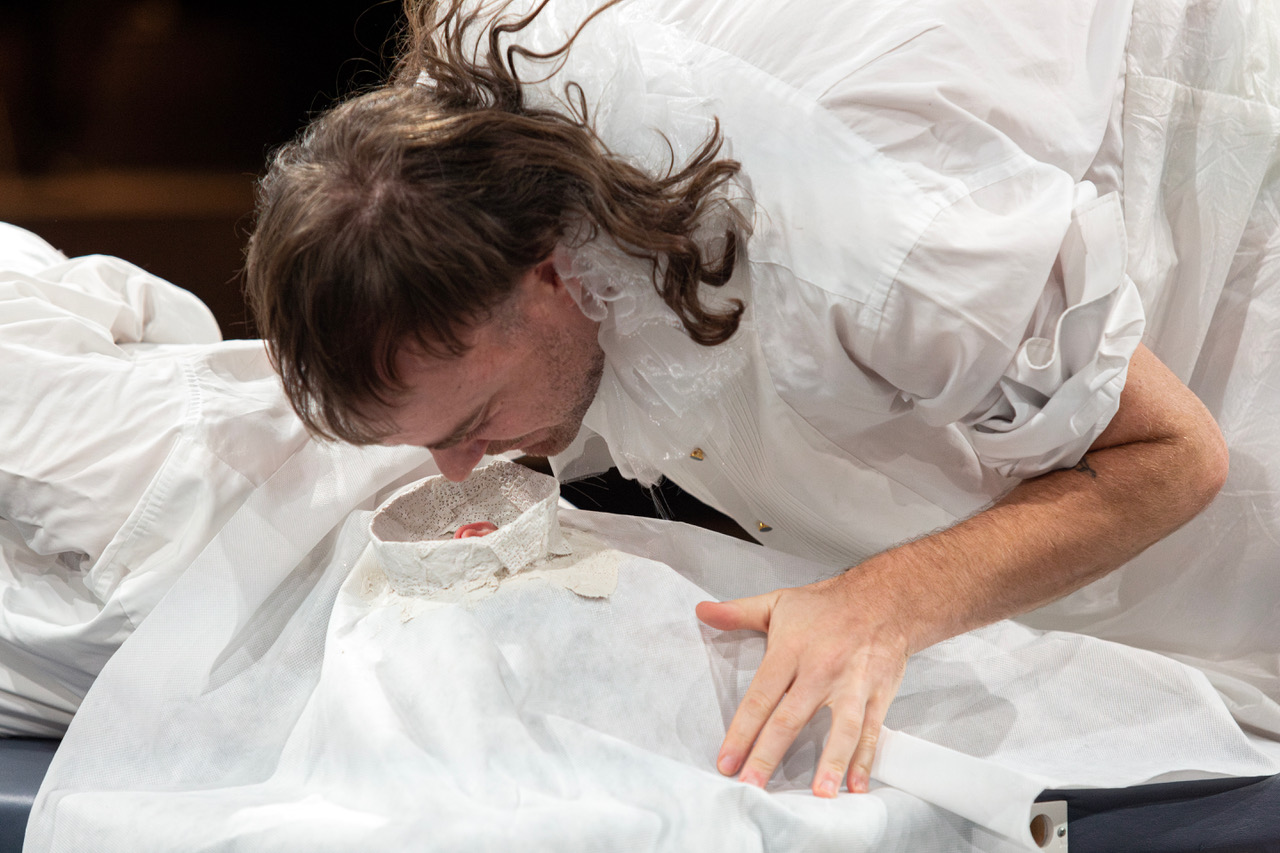
Freut euch des Lebens (2025)

für Sprecher in tauchausrüstung, ensemble und elektronik

line-up: aquanaut, 2 flutes, oboe, clarinet, 2 horns, trumpet, trombone, percussion, e-guitar, keyboard, 2 violins, viola, violoncello, contrabass
duration: 12′
date of premiere: 15.8.2025, Black Page Orchestra, conductor Irene Delgado Jimenez, OCT.OPUS25 Karlsplatz Wien

MUSIK IM BILD: UNTERMALUNg- ÜBERMALUNG

Omaggio A Ennio Morricone

line-up: soprano, flute, clarinet, trumpet, trombone, tuba, percussion, piano/keyboard, e-guitar, accordion, 2 violine, viola, violoncello, contrabass, electronic and video
duration: 18′
date of premiere: 8.5.2025, Black Page Orchestra, conductor Marino Formenti, Musikverein Wien

The piece consists of free associations and incomplete experimental setups exploring the relationship between image and sound. In three chapters focusing on space, figure, and action, static images are painted over, locations are shifted and reinterpreted, movements are underscored and expectations provoked, emotional states are inscribed into pairs of eyes, and visual as well as sonic cross-references are continually generated.

The whole work is framed by two songs that reference, in particular, the collaborations between Ennio Morricone and Pier Paolo Pasolini — first in the opening credits, which musically introduce the members of the ensemble one by one (as in Pasolini’s film Uccellacci e uccellini, where Ennio Morricone has the opening credits sung as an offbeat pop tune), and later in the end credits, where I set to music one of Pasolini’s late poems about music, l’orecchiabile (“the catchy tune”).

Das Stück sind freie Assoziationen und unvollständige Versuchsanordnungen zur Beziehung von Bild- und Tonebene. In 3 Kapiteln zu den Aspekten von Raum, Figur und Handlung werden statische Bilder übermalt, Orte versetzt und umgedeutet, Bewegungen untermalt und Erwartungen provoziert, seelische Zustände in Augenpaare eingeschrieben und immer wieder visuelle wie klangliche Querverweise erzeugt.

Das ganze wird umrahmt von zwei Songs, die insbesondere auf die Zusammenarbeiten von Ennio Morricone mit Pier Paolo Pasolini Bezug nehmen – einerseits im Vorspann, der die Mitglieder im Orchester der Reihe nach musikalisch vorstellt (wie in Pasolinis Film “Uccellacci uccellini”, wo Enno Morricone die Credits im Vorspann als schrägen Schlager vorsingen lässt), und andererseits im Abspann, wo ich ein spätes Gedicht Pasolinis über Musik, l’orecchiabile (der Ohrwurm), vertone.

combative music and its algorithmic demystification

line-up: flute, soprano/tenor saxophone, e-guitar, piano, percussion, 4-channel-electronics
duration: 11 minutes
date of premiere: 01.07.2021, BLACK PAGE ORCHESTRA, Fabbrica del Vapore, Milano

The piece starts in the present and finishes in a not so distant future. All forces of human mankind are united, even the most athletic ones on the planet, for the final combat against enslavement by machines. Will humanity be able to tame the algorithm before it eats the world? You won’t believe what happens next!

https://theblackpageorchestra.bandcamp.com/track/combative-music-and-its-algorythmic-demystification

PITCH STUDY NO.2 / THe 88 piano Keys

line-up: grand piano, 2 keyboards
duration: 20 minutes
date of premiere: 18.05.2022 BLACK PAGE ORCHESTRA, Musikverein Wien

exists also in an alternative version for grand piano and 1 keyboard

The piece treats each key of the piano in an informative, disinformative, narrative, musical or non-musical way, starting in order from the lowest to the highest note.

The individual octaves form 7 chapters. During the composition, the listener learns, among other things, to distinguish the rustling of wind in different types of trees, how the physical condition of guinea pigs can be changed by 8-hour exposure to a 116 hertz frequency, how the 2mm insect Lesser Waterboatman achieves a sound of 96 dB with its penis, at which cytological position in the genome of the fruit fly one can adjust the pitch of its mating call, or how often the “a” occurs in all 32 Beethoven sonatas.

No animals were harmed for the piece, except for one.

Encyclopedia of Pitch and Deviation

ENCYCLOPEDIA OF PITCH AND DEVIATION

line-up: flute, oboe, horn, trombone, e-guitar, accordion, percussion, 2 keyboards, violin, viola, violoncello, contrabass
duration: 21′
date of premiere: 18.11.2020, Klangforum Wien, Wiener Konzerthaus

TABLE OF CONTENTS:

  • 17000 – 20000 Hertz: The Mosquito Alarm
  • 3500 Hertz: The Dentsply Sirona Midwest Stylus Plus Air Driven High Speed Dental Drill
  • 1500 Hertz: The spin speed of a Zippe-type gas centrifuge for enrichment of Uranium-235 used as fuel for light water nuclear reactors and nuclear weapons
  • 686 Hertz: La Bomba (The Emperor) – High Performance Blender and Smoothie Maker
  • 500 Hertz: The highest wing beat frequency of the Chironomids, the Lake Flies.
  • 443 Hertz: Concert Pitch, continental European standard
  • 350 Hertz: The highest wing beat frequency of the Vegetable Leafminer.
  • 333 Hertz: The Simlug Barbecue Electric Fan Blower Ultraspeed Pro
  • 300 Hertz: The highest wing beat frequency of the western honeybee
  • 256 Hertz: the middle C in the alternative Verdi Tuning, also Philosophical or Scientific Pitch
  • 250 Hertz: The spindle motor of a Hard Disk Drive rated at 15000 rpm
  • 221.23 Hertz: The frequency of the Brow Chakra, the Third Eye
  • 210.42 Hertz: The frequency of the Navel Chakra
  • 200 Hertz: The wing beat frequency of the housefly
  • 194.18 Hertz: The frequency of the Base Chakra, the intestines
  • 172.06 Hertz: The frequency of the Crown Chakra
  • 150 Hertz: The redline speed of the Renesis 13B engine in a Mazda RX-8
  • 141.27 Hertz: The frequency of the Throat Chakra
  • 136.1 Hertz: The frequency of the Heart Chakra
  • 126.22 Hertz: The frequency of the Solar Plexus Chakra, the upper abdomen
  • 42 Hertz: The maximum spin speed of a Gorenje WA65 washing machine
  • 32.5 Hertz: The Schumann Resonance 5th order
  • 26.4 Hertz: The Schumann Resonance 4th order
  • 20.3 Hertz: The Schumann Resonance 3rd order
  • 14.1 Hertz: The Schumann Resonance 2nd order
  • 7.8 Hertz: The Schumann Resonance fundamental mode

THE COMPLETE UNFIGURANTED EGALITARIAN AURAL REALISM PT.1

line-up: (digital) flute, (digital) viola, electronics (version 1.2 with flute, violin and electronics)
duration: 13 minutes
date of premiere: 10.01.2019 NIMIKRY, Porgy&Bess Vienna

commissioned by and written for NIMIKRY

recorded live @ Porgy&Bess Vienna, 10.1.2019
NIMIKRY: Alessandro Baticci, digital flute,
Rafal Zalech, digital viola

“Which was why, the wraith is continuing, the complete unfiguranted egalitarian aural realism was why party-line entertainment critics always complained that the wraith’s entertainments’ public-area scenes were always incredible dull and self-conscious and irritating, that they could never hear the real meaningful central narrative conversations for all the unfiltered babble of the peripheral crowd, which they assumed the babble was some self-conscious viewer-hostile heavy-art directoral pose, instead of radical realism.” (from David Foster Wallace, Infinite Jest)

Ghost Box Music

Ghost Box Music – for ensemble and virtual narrator

line-up: flute, clarinet in B, 2 violins, viola, violoncello, accordion, zither,  stereo-playback
duration: 13 minutes
date of premiere: 19.2.2018, Musikfabrik Süd, Gemeindezentrum St. Ruprecht Klagenfurt

Das Stück handelt von Zufall und dessen Deutung, Gesprächen von Verstorbenen mit niemals Geborenen (künstlicher Intelligenz), Täuschung durch Erwartungen und unsere Software-abhängigen Wirklichkeiten.

Über einen Lautsprecher wird ein Text mittels Text-to-Speech-Software wiedergegeben, indem die Entstehung der Komposition beschrieben wird, nämlich die Analyse zufälliger Radioaufnahmen hinsichtlich von Tonhöhenfrequenzmustern und vermeintlichen Geisterstimmen auf der Aufnahme.


Pancrace Royer: The harpsichord pieces

I – La Marche de Scythes
II – La Sensible

line-up: flute/alto fulte, tenor recorder/alto recorder, harpsichord, electronics (stereo-playback plus subwoofer, clicktrack)
duration: 15 minutes
date of premiere: 13.10.2017, Airborne Extended, Minoriten Graz


The composition is based on pitch data extracted from two of the harpsichord pieces by the french baroque composer Joseph Nicolas Pancrace Royer, and an investigation in tonality.
In the first piece (la marche de scythes) all the notes of the piece where taken and sorted from the lowest to the highest. the result is an ascending, nearly chromatic line, repeating every note as often as it appears in the original piece. this leads to interesting tonal phenomenons, percepting tonality as a matter of statistical weights, as well as hearing a permanent leading-note.
The second piece steps through all the pitches of the piece in subsequently, merging them to chords, creating kind of pseudo-cadenzas and deformed harmonic developments.